
Six proprietary platforms turning waste streams into defense-grade materials, advanced batteries, and resilient infrastructure.


Upcycling Caribbean (IWUP)
Integrated Waste Upcycling Plants converting municipal solid waste into syngas, electricity, and advanced carbon materials using JFE Engineering shaft-type gasification. Zero-landfill technology designed for island and coastal communities. Currently developing projects in the U.S. Virgin Islands.
Learn more on our dedicated Upcycling Caribbean page
Structural Supercapacitor Wall
A wall already carries load, resists hurricanes, and lasts a century. We add a fourth job: storing electricity. Each concrete panel holds a laminated stack of 42 double-layer supercapacitor cells, with graphene and single-walled carbon nanotube electrodes on a basalt-fiber scaffold and an ionic-liquid gel electrolyte. The storage element contains no lithium and has no thermal-runaway pathway, and it is designed to tolerate EMP, with the supporting electronics in a shielded enclosure.
Design basis, per 4 ft × 8 ft × 8 in panel: about 1 kWh usable and 1 kW continuous. A 15-panel string is planned at about 15 kWh usable and 15 kW, or roughly three days of critical loads or one day of a whole Puerto Rico home, recharged by about 2.8–4.8 kWp of solar.
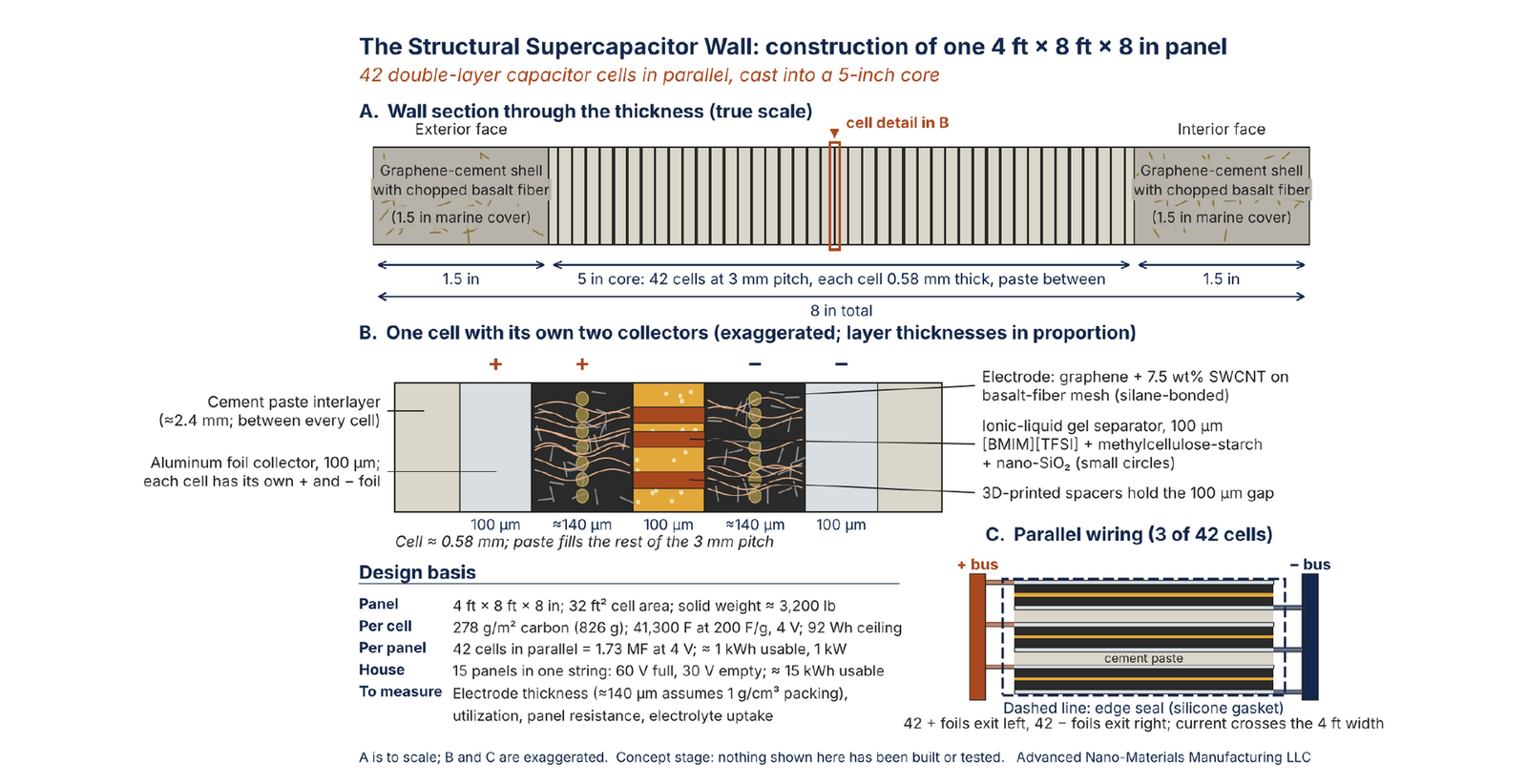
Status: Design and modeling are complete. Figures are design estimates, not test results. The next step is a full-size test panel to measure utilization, resistance, and electrolyte uptake.
EMPCrete
EMP-hardened building materials meeting MIL-STD specifications for electromagnetic pulse survivability. Graphene-doped concrete and Faraday cage shielding systems designed to keep critical infrastructure — data centers, command facilities, power stations — operational when the grid goes down. Combines structural strength with electromagnetic protection in a single pour.
GraphPlast
Graphene-enhanced asphalt and polymer modifiers that extend road life 3–5x. Our proprietary process converts waste plastics into high-value graphene nanoplatelets, which are then blended into asphalt binders and polymer matrices. The result is roads that last longer, cost less to maintain, and start with materials that would otherwise end up in landfills. Provisional patent with Power Solar as the anchor customer for roof coating applications.
TBM-100 Battery System
Aluminum-ion battery technology with graphene-enhanced cathodes. Non-flammable, fully recyclable, and EMP-survivable. Designed for defense installations, grid-scale storage, and critical infrastructure backup where lithium-ion is too dangerous or too dependent on foreign supply chains. Provisional patent.
BFRP Corrugated Marine Panel
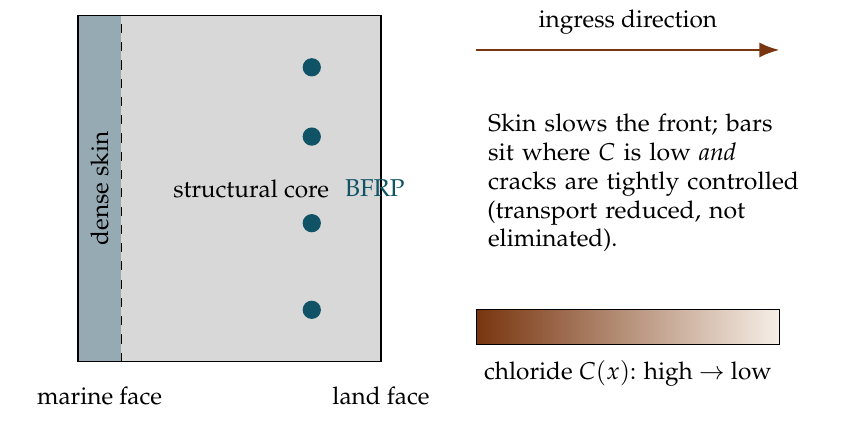
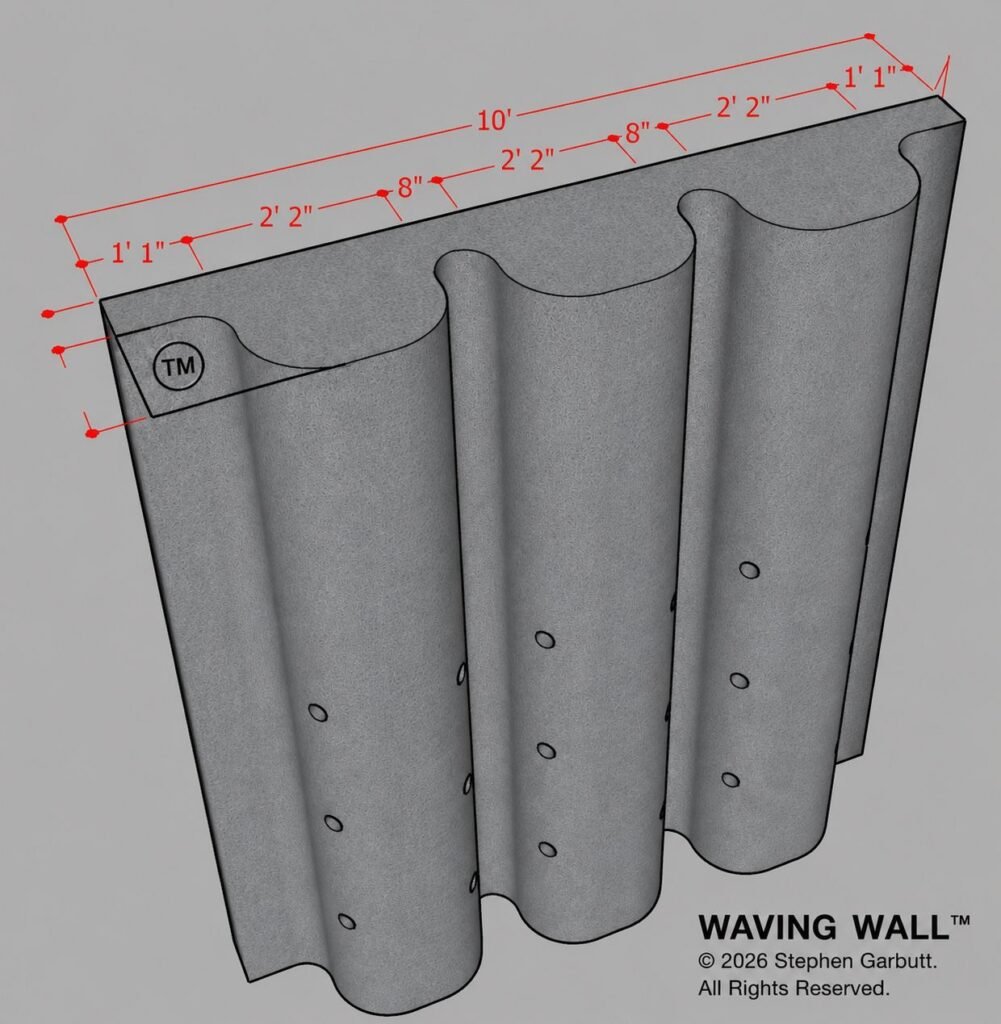
Seawalls fail because the steel rusts, not the concrete. We replace the steel with basalt fiber-reinforced polymer (BFRP) rod, which cannot corrode electrochemically, and cast the panel in our graphene-enhanced concrete to slow the chloride front. The corrugated shape supplies the stiffness, and prestress keeps the panel uncracked under working load.
Design basis: a dense low-permeability skin on the marine face, a structural core carrying the BFRP where chloride is lowest, a cast-in tongue-and-groove interlock with a grouted shear key, and a continuous cap beam. Panels are precast in reusable molds. The 75 to 100 year service life is a design target, not a claim. It depends on verified mix permeability, BFRP durability data, and project-specific service-life modeling.
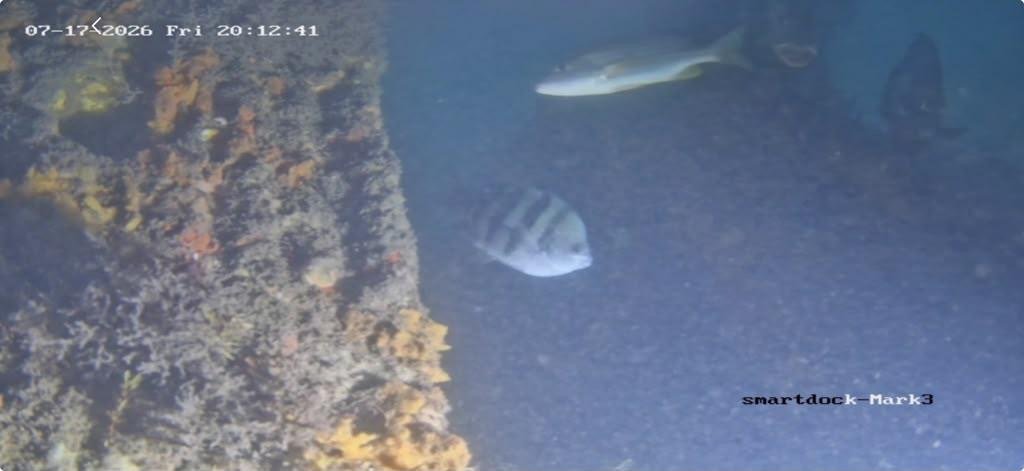
Status: installed in the ocean. The photo above shows the wall underwater in July 2026.